UK: Police attempt to remove loyalist bonfire 'hate display'
July 10, 2026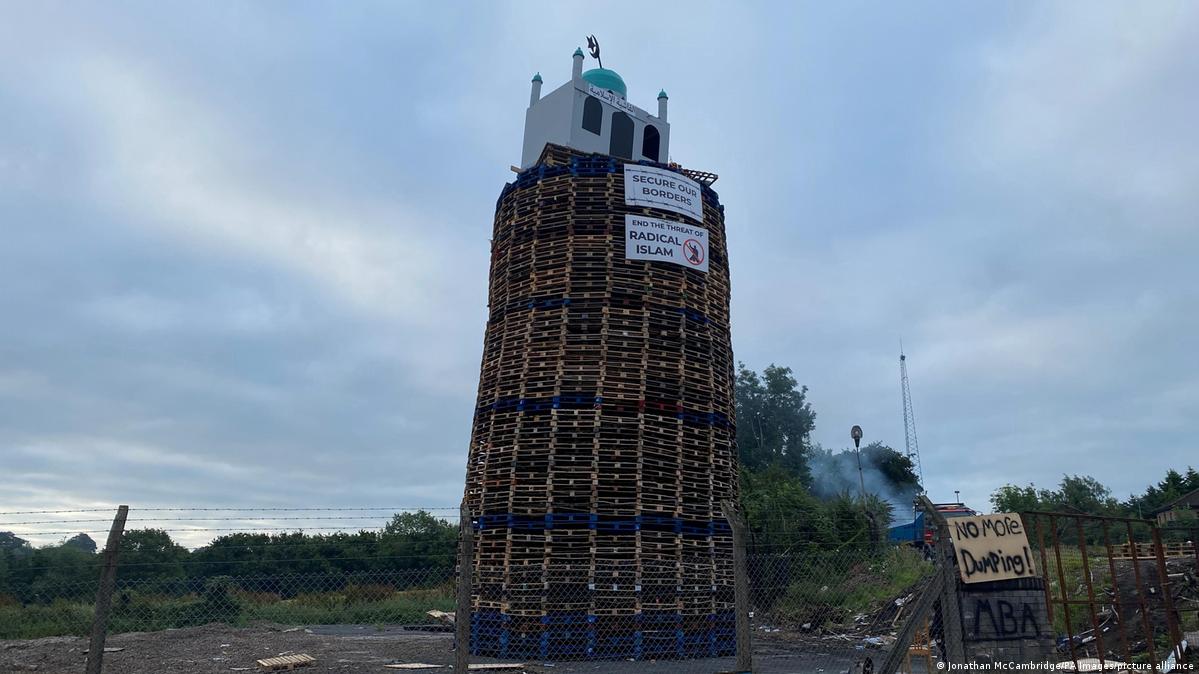
In a troubling turn of events, police in the United Kingdom faced a race against time to dismantle a controversial display from a loyalist bonfire in Northern Ireland. Set for lighting, the bonfire had already been ignited prematurely by its organizers, who reacted to police efforts to remove a replica mosque, which many officials denounced as a hate symbol.
The Police Service of Northern Ireland (PSNI) described the situation at the bonfire in Moygashel, County Tyrone, as a serious violation of laws against hate crimes. A 56-year-old man was charged with incitement to hatred for his role in the event. The PSNI initiated a wide-ranging operation to secure the site and eliminate the inflammatory display, but the efforts were thwarted as the bonfire was lit before they could complete their task.
In a statement, a PSNI spokesperson lamented that their plan to collect evidence and remove the hateful material was disrupted. They emphasized their commitment to acting against hate crimes, stating, "Had the bonfire not been lit, police would have secured the site, removed the offending material, and seized it as evidence."
Chief Superintendent Norman Haslett expressed unequivocal disapproval, stating, "Hate crime has no place in our society and will not be tolerated." He added that the proactive police operation was a necessary measure to address the confrontation in Moygashel, a heavily Protestant area.
Northern Ireland's Bonfire Tradition Explained
The provocative inclusion of the mosque replica, emblazoned with the Arabic words "Islamic fascism," drew strong criticism from diverse quarters including political leaders and human rights organizations. The nationalistic symbols and slogans placed on the bonfire, like "Secure our borders" and "End the threat of radical Islam," are indicative of the charged atmosphere surrounding the “Eleventh Night,” a time when unionists commemorate key historical Protestant victories.
The bonfires, associated with the Glorious Revolution of 1688 and the subsequent Protestant triumph at the Battle of the Boyne in 1690, serve as focal points for unionist identity in Northern Ireland. Participants look to reinforce their commitment to remain part of the UK amid ongoing debates about Irish unification.
Traditionally, most of these bonfires are festive and pass without incident. However, the introduction of anti-Catholic and anti-immigrant symbols in recent years has resulted in significant national controversaries. Events like these often fan the flames of division, as seen in last year's display in Moygashel, where burning effigies of migrants sparked outrage amid already heated discussions on immigration policy in the UK.
This year, the incident unfolds against a backdrop of recent violent anti-immigration riots, further complicating the narratives of both loyalty and hatred within this divided society.
Bonfire Organizers: 'Political Protest'
Emerging from these tensions are statements from the Moygashel Bonfire Association, which framed the mosque’s inclusion as a necessary "political protest" against what they term "uncontrolled illegal mass immigration." They argue their actions represent broader public concerns rather than personal attacks against Muslims.
In their defense, organizers insisted that their display is not aimed at individuals but at "ideology and government policy." They maintained, "If there was no uncontrolled illegal mass immigration, we would have no need to protest on this issue." This claim poses questions about the intersection of political expression and public safety in deeply polarized communities.
Critics: 'A Cowardly Intimidation'
However, responses from local politicians and religious leaders sharply contrast this portrayal. UK Northern Ireland Secretary, Hilary Benn, characterized the replica mosque as a "sickening and cowardly act of intimidation" that fails to represent the majority sentiment in Northern Ireland. Amnesty International has condemned the display as a "vile attempt" to incite anti-Muslim animosity.
Jointly, local church leaders from both Protestant and Catholic backgrounds have described the act as "grossly offensive" and called for a move towards mutual respect amongst faiths. They urged all people to consider how actions like this stoke division and potential violence against innocents.
Unionist Politicians: Balancing Culture and Law
Despite concerns over sectarian symbols, unionist politicians have defended the right to celebrate community traditions, asserting that protests should remain lawful. A spokesperson for the Democratic Unionist Party (DUP) reminded that the bonfires have a long history going back to the time of King William III, emphasizing that they should reflect positive cultural expressions rather than offensive displays.
Ulster Unionist Party (UUP) leader Jon Burrows condemned the mosque replica, insisting its presence undermines an important cultural tradition and damages Northern Ireland's international reputation. He asserted that the negative imagery surrounding this year's bonfire does not represent the essence of unionist celebrations.
Edited by: Sean Sinico
Don't let the algorithm hide the news. If you rely on our team for trusted reporting, please take a moment to and hitting the "star" or "preferred" button, so you'll always see our verified news first.