‘Statelessness is not always the absence of a country. Sometimes it is the erosion of belonging’
Originally published on Global Voices
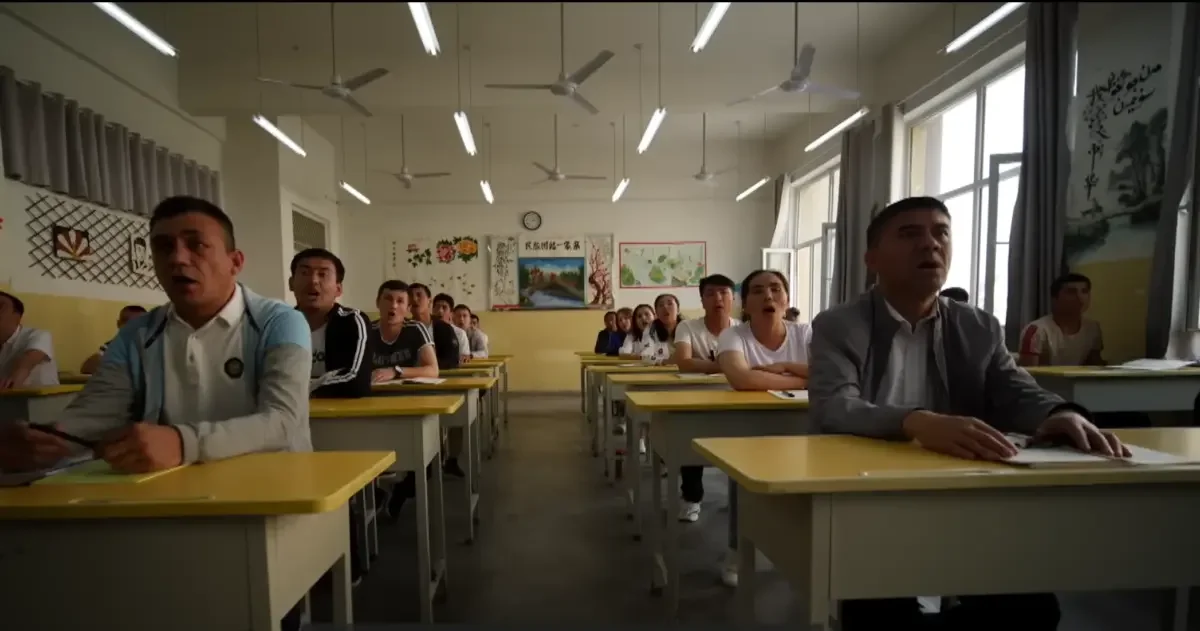
Inside a re-education camp in Xinjiang. Screenshot from BBC News’ YouTube Channel. Fair use.
This post is part of Global Voices’ July 2026 Spotlight series, “Statelessness.” The series sheds light on statelessness and its profound effects on freedom and identity.
My journey into understanding statelessness began in what many recall as an idyllic childhood, just as China's era of Reform and Opening Up was dawning. Born just after the tumult of the Cultural Revolution, I was sheltered from its chaos. Instead, I experienced a youth marked by warmth: laughter during family outings, jubilant activities at school, and radiant days marked by celebration.
But underneath these surface joys lay a complex reality that slowly became visible as I grew. I vividly remember being entranced by lessons on evolution, only to return home filled with curiosity. My father's retort—suggesting perhaps my teacher had ties to monkeys, but affirming our creation by Allah—highlighted deeper currents. He wasn't just discussing science; he was fiercely defending our identity as Uyghurs amidst a narrative that was, at its core, minimizing.
Reevaluating Identity Amidst Societal Shifts
As I progressed through life, questions of identity surged within me. The Uyghur presence, rich with its distinct language and culture, contrasted starkly against the Han majority's dominance. I became increasingly sensitive to the unequal distribution of life chances. My father’s wisdom—emphasizing the indifference of both Mao Zedong and Deng Xiaoping to Uyghur lives—resonated more profoundly as I observed the widening discrepancies in educational and professional realms.
The complex entanglement of our existence became clearer with the writings of Ilham Tohti, who articulated the very frustrations many Uyghurs quietly bore year after year. His insights into employment disparities and cultural erasure echoed the emotions I had long suppressed. Yet, even as we grappled with these challenges in silence, life progressed; we coexisted with Han Chinese, sharing schools and workplaces without openly acknowledging our grievances.
This uneasy cohabitation shattered on July 5, 2009. Following a tragic incident involving the killings of Uyghur workers, a palpable tension enveloped our society. I was caught in the chaos by fate’s design, returning home just as Urumqi erupted. Witnessing a frantic rush to the streets and hearing cries of distress transformed my familiarity into fear. For the first time, I felt the vulnerability of my community, a painful awareness of how thin the veil of normalcy could be.
Aftermath and Transformation of Relationships
The turmoil of that day was not an isolated event. A profound shift in community dynamics ensued. Tensions that once simmered beneath the surface began to freely express themselves, fracturing relationships that were once close-knit. Our shared spaces—once teeming with camaraderie—groaned under the pressure of silent mistrust. Conversations that felt natural turned awkward, and the invisibility of our disconnect became glaringly apparent.
Years passed, and post-2017, the specter of state oppression loomed larger than ever. Many Uyghurs were swept into detention under a regime that quashed cultural expression and language. Entire communities fractured as fear became interwoven into the fabric of daily life. The loss wasn’t only tangible in the form of physical absence; it infiltrated our language, our celebrations, and our aspirations. A pervasive sense of statelessness had settled into our psyche—no longer mere anxiety about physical borders, but a profound loss of belonging within the very land we called home.
Reflecting on these experiences now, statelessness emerged not as a sudden realization or a result of exile. I had come to recognize it long before crossing borders. It manifested through observed disparities, broken connections, and the slow unraveling of the bonds that tethered me to my homeland. The chasm between me and my Uyghur identity widened each year, accompanied by a chilling sense of estrangement.
The Pain of Rediscovering Belonging
My father's absence, his teachings now relegated to memory, deeply illuminates my narrative. At first, I believed I was grappling with politics and cultural teachings. Eventually, however, I unearthed the heart of his lessons—belonging. He was imparting the critical notion that citizenship does not equate to belonging. In modern discourse, citizenship is often confused with identity, yet they remain distinctly different. One can hold a passport and still encounter profound political invisibility, existing on the periphery of one’s society.
Such realizations have weighed heavily as I revisit my past. Many assume that the lesson of statelessness is one experienced in exile. Yet for me, that painful lesson was imbued in childhood memories within my homeland. I learned of statelessness as relationships fractured, trust eroded, and the threads connecting me to my heritage grew frayed.
In essence, a homeland cannot solely be characterized by geography; it thrives through the relationships we nurture there. When those relationships deteriorate, the fabric of belonging rapidly disintegrates. My understanding of statelessness has deepened, affirming it as a complex emotional and social experience rather than merely a political or legal status. It’s the quiet feeling of separation from one’s own land, where cultural, linguistic, and communal ties begin to fray. For many Uyghurs, this sense of distance from their homeland has become increasingly profound.