Escalating aid cuts and severe poverty are driving Rohingya girls towards early marriages, deepening their plight and silencing their futures.
Originally published on Global Voices
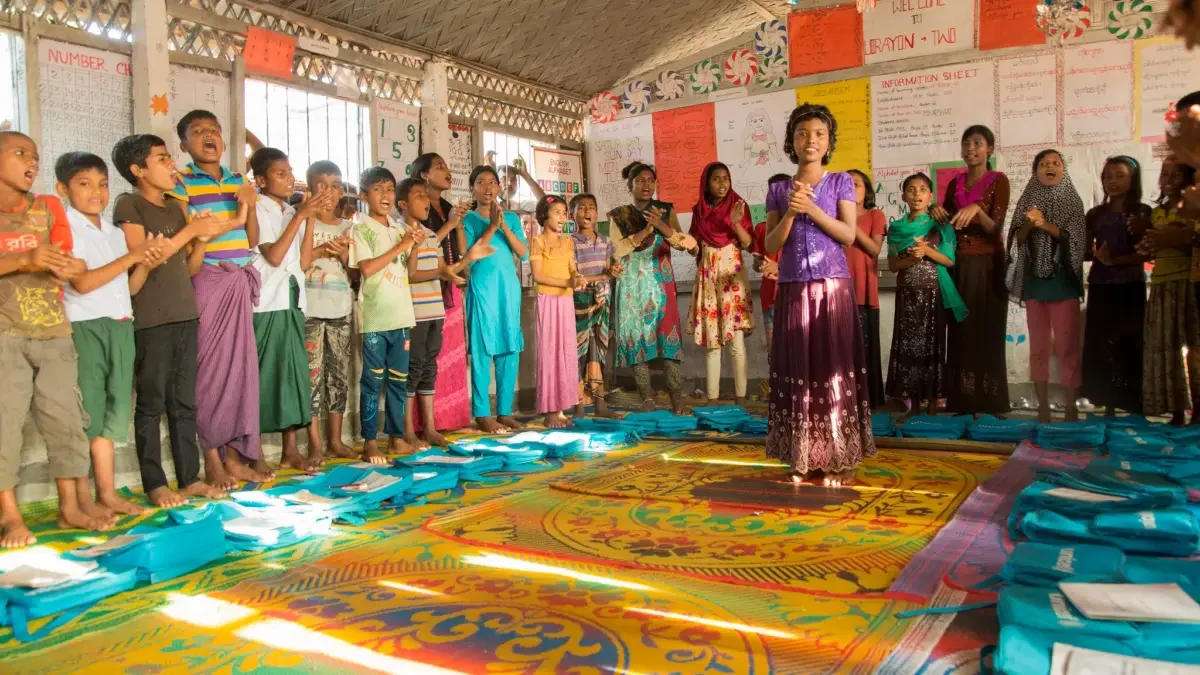
Inside a Bangladesh refugee camp, a classroom of Rohingya children engage in English songs at a UNICEF learning centre, supported by UK aid. Photo credit: Anna Dubuis/DFID via Flickr. CC BY 2.0.
This piece is part of Global Voices’ July 2026 Spotlight series, “Statelessness,” focusing on the challenges of statelessness and its impact on societal rights and opportunities.
The Rohingya remain the largest stateless group globally, a situation entrenched by Myanmar’s systematic denial of their citizenship. Nearly nine years after over 750,000 Rohingya fled violence in Rakhine State for Bangladesh, around one million remain bottled up in 33 overcrowded camps in Cox’s Bazar. This lack of citizenship deprives them of fundamental rights like education and healthcare, forcing reliance on fluctuating aid.
In the absence of state protection or enforcement of rights, marriage often emerges as the only perceived pathway to security for families.
At 13, Maryam, a Rohingya girl from the Kutupalong refugee camp, saw her world change drastically when her learning center was shuttered due to funding cuts from USAID in 2025. Within weeks, her mother consented to a marriage arrangement with a 34-year-old man, influenced by local religious authorities who cautioned that delaying marriage post-puberty poses spiritual dangers. The minimal dowry—a mere two thousand Taka, approximately USD 16—was an irresistible appeal for her family, especially given their financial struggles.
Despite the legality of marriage being set at 18 for women in Bangladesh, Maryam's case reflects a common trend. The camp's majhee, responsible for managing local resources and marriages, prepared the informal contract without any oversight. Today, at just 14 years old, she is now pregnant and barred from returning to school.
A Widow’s Difficult Decision
In a similar vein, the story of Suriya, a 40-year-old widow in camp 20, reveals the harrowing pressures faced by these families. Struggling after losing her husband during their flight from Myanmar, she faced insurmountable debt. Her daughter, Fatima, at 14, became the target of an informal marriage proposal orchestrated by the community’s majhee, who needed a fourth wife to assert dominance in the community. This arrangement was not only seen as a solution to Suriya's challenges but also an expectation within her environment, indicative of the coercive dynamics present.
Such scenarios are pervasive in the camps, symptomatic of a larger, troubling pattern.
The Data Behind the Growing Silence
What transpires within these camps often remains cloaked in silence, with documented cases of child marriage among the refugee population climbing by 21 percent last year. Reports indicate that child abductions surged to over 560 incidents, and instances of children being recruited by armed groups increased eightfold in 2025. Prior to the latest funding downturn, research indicated that the average age for first marriages among Rohingya girls was just 15.7 years, with over 62 percent marrying before the age of 18.
Patrick Halton from UNICEF has made the connection between these troubling statistics and the recent school closures, pointing out that diminished educational opportunities have led to a spike in child marriages as families seek alternative stability.
One teacher corroborated this pattern, noting that marriage is a significant reason for girls dropping out of school, with in-laws often prohibiting their return.
The Intersection of Faith and Consent
There's a troubling dynamic at play regarding why families like Maryam's do not resist such pressures. The prevailing belief in these camps is that once a girl reaches puberty, she must marry to avoid sin. This belief is propagated by local religious leaders, which entrenches the practice as families prioritize early marriage over educational opportunities.
A humanitarian project manager explained the reality that many girls enter into marriages without any understanding of their rights or sexual health, many believing they must tolerate abuse as normal. This lack of education reinforces systemic violence.
Furthermore, educational preferences often lean towards religious madrashah schools for basic Quranic teachings rather than a broader schooling framework, complicating the landscape even further and ensuring that conventional education often struggles for relevance.
When Dowries Disappear
Historically, financial obstacles such as hefty dowries had curbed the prevalence of child marriage in Myanmar. However, this financial structure has collapsed within the camps, with dwindling costs leading to an uptick in marriages occurring below the legal age. The camp's ration system allows men to sustain multiple wives without independent income, undermining traditional economic rationale against polygamy.
The Silence of Protection
In the camps, instances of child marriage and gender-based violence frequently occur without accountability. While formal processes exist for marriage approval and age verification, the reality is a stark contrast—with rampant evasion and minimal oversight by authorities. Community members often remain silent, fearing repercussions that could jeopardize their access to basic needs such as food and shelter.
The structures meant to protect these vulnerable populations have become ineffective, leading to a bleak situation for girls trapped in early marriages, pregnancies, and trafficking. The increase in child marriages reflects a systemic failure, where the intersection of aid cuts, polygamy, and entrenched socio-economic factors conspire against the rights of these young girls.
Maryam and Fatima represent not isolated tragedies but rather the outcomes of a disintegrating system that has failed to safeguard the very individuals it was meant to protect. The pressing question remains whether the international community will recognize its role in creating conditions that facilitate such crises.