‘Where museums catalog ‘duck-shaped kohl containers’ without context, we should see the generations of craftsmanship behind them.’
Originally published on Global Voices
While perusing the Metropolitan Museum of Art's collection of kohl containers, I noticed a glaring absence of context surrounding these items. Their descriptions often lack fundamental information about the artisans who crafted them, their intended users, and the subtle sensory experiences they provide. Reflecting on my own family's heritage, I realized that every everyday object carries a rich tapestry of stories—its creator’s identity, functional nuances, and even emotional connections through generations.
This gap in historical records provokes a critical question: how can we honor the intricate histories of everyday objects? To appreciate an item fully, it's imperative to document its biography—covering not just its creation but also its sensory experiences and the often-overlooked people who embrace these tools in their daily lives.
Cultural Narratives and Domestic Life
The absence of such documentation isn't confined to institutions like museums. It extends into local historical records. Take, for instance, the 1962 gazetteer for Bhagalpur in Bihar, where my family's stories are rooted. While these documents shed light on agricultural implements—tools associated with visible labor—they neglect domestic objects like the kajrauti (kohl container) that women often use, effectively skewing the narrative toward economic productivity while overlooking domestic cultural practices.
This bias highlights a broader societal ignorance of women’s contributions, reinforcing the need for a more inclusive historical archive. The mundane tools of daily life not only serve practical purposes but also weave intricate narratives reflecting class and gender dynamics in society.
Personal Heirlooms as Cultural Artifacts
Motivated by this realization, I began documenting everyday objects within my own home, including kohl containers that have transcended generations. The duck-shaped kajrauti mentioned on the MET’s site triggered memories of a similar one from my family, intricately linked to my lineage. Crafted by my maternal grandfather in a steel factory, this heirloom symbolizes cultural continuity, connecting me to both the past and present.
Despite not using kohl regularly, the mere act of unsealing the container evokes memories—the familiar scent of ghee and soot mingling as they unlock not just memories but also a conversation with my family's history.
Everyday Objects and Their Meanings
The Paila (Grain Measuring Utensil)
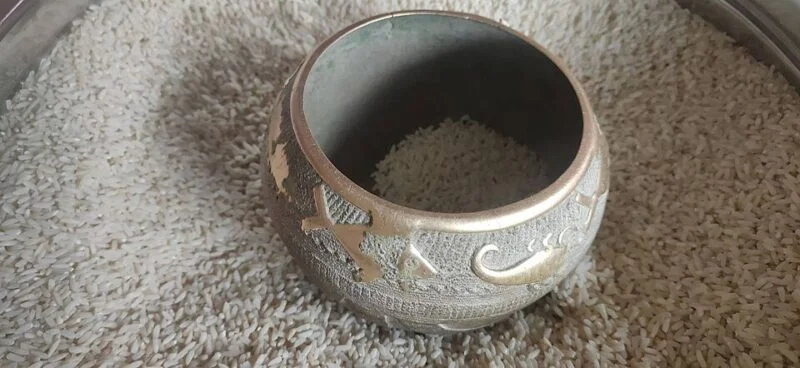
Paila, a kitchen utensil used to measure rice in Bihar, India. Photo by Amrit Sufi on Wikimedia Commons (CC BY-SA 4.0).
Another enduring symbol of domestic life is the paila, an essential measuring device for rice used during family meals. My memories of watching my grandmother skillfully dip it into stored rice resonate deeply with the patterns embossed on its surface—motifs that speak to my cultural context. Each paila holds not just a practical function but retells tales of community gatherings, culinary traditions, and the craft of local artisans.
The Maliya (Oil Container)
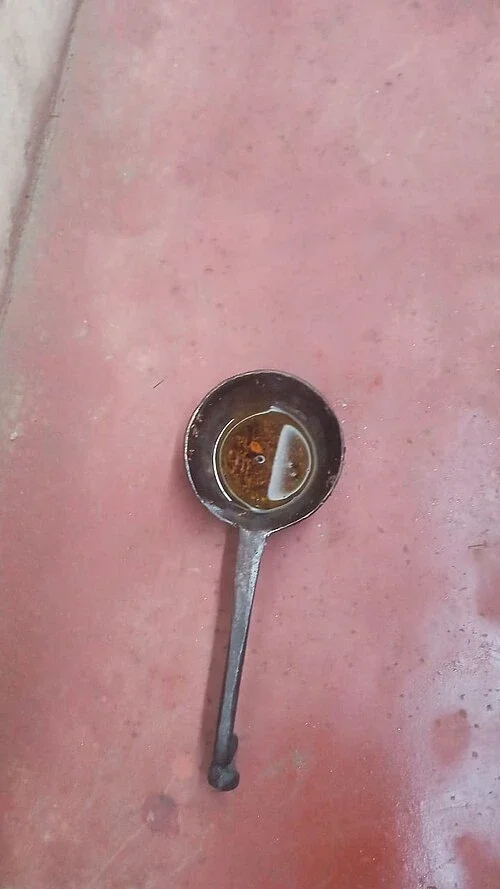
Maliya is an open oil container that is used for massages, usually made of iron. Photo by Amrit Sufi on Wikimedia Commons (CC BY-SA 4.0).
Lastly, the maliya, an open oil container, serves as another poignant reminder of my gran's nurturing presence. Designed for comfort and utility, its role extends beyond merely holding oil; it's part of the tender memories of care shared among family members, passed down through generations like the maliya itself.
A Call to Document and Preserve
Such artifacts are more than just components of daily life—they expose the intricate web of social and economic relationships within Indian society. Many of these objects were built to be durable and passed down as heirlooms, yet the skills needed to create them fade as traditional practices decline.
Embracing our material culture requires us to appreciate these tools beyond their superficial utility. They hold knowledge about family structures, local skills, and cultural histories critical to maintaining a rich societal tapestry. But alas, when traditional items are overshadowed by mass-produced alternatives, generations of cultural wisdom face erasure.
To tackle this loss, anyone with access to digital tools can start documenting these stories. By sharing images and narratives on open knowledge platforms, we can collectively ensure that future generations understand the significance of everyday objects—transforming them from mere artifacts into vibrant storytellers of our cultural inheritance.
Feel free to reach out to me via my Global Voices profile if you want to discuss ways to make these everyday objects visible.


.jpg)